
Your content team publishes consistently. Your keyword research is thorough. Yet competitors with fewer resources outrank you, and you’re not sure if you need better tools, better strategy, or both.
As one user on r/SEO described:
“I hired an SEO agency to improve the rankings of my site. They keep making promises and saying that ‘SEO takes time’ but I see absolutely no results. Traffic had actually dropped. They sent me tons of screenshots of success stories, before having me commit.” u/semlowkey
This guide ranks eight topical mapping solutions based on what actually enables authority-building decisions: true total costs including hidden add-ons, multilingual capability depth, documented ROI evidence, and honest limitations that generic comparisons skip. We’ve verified competitor claims, tested pricing transparency, and structured the comparison to help you choose quickly.
Full Disclosure: This guide is published by Rank Globally, ranked #1 below. We’ve applied identical evaluation criteria to ourselves and competitors, verified competitor information independently through third-party sources, and present their strengths fairly so you can make an informed decision.
Quick Comparison
| Rank | Service | Best For | Key Capabilities | Primary Strength | Key Limitation |
| 1 | Rank Globally | Companies needing execution + multilingual expertise | Strategy implementation, conversion design, multiregional SEO | Only service combining topical mapping with conversion accountability | Self-service teams may prefer software autonomy |
| 2 | Surfer SEO | Existing Surfer ecosystem users | GSC integration, hexagonal clusters, Content Score | 0.28 ranking correlation provides measurable guidance | Generic clusters require strategic refinement |
| 3 | MarketMuse | Large content libraries (200+ posts) | Topic Inventory, Personalized Difficulty, Heatmaps | Prevents wasted effort on impossible keywords | $600+/month cost, steep learning curve |
| 4 | SEMrush | All-in-one SEO platform users | Keyword Strategy Builder, Topics Report, intent labeling | 300% traffic case study demonstrates results | Topical mapping is ancillary feature, not core focus |
| 5 | Frase | Multilingual content velocity | 100+ languages, GEO for AI search, SERP briefs | Industry-leading multilingual + AI search optimization | AI writing quality requires heavy human editing |
| 6 | Ahrefs | Speed-focused existing subscribers | Instant 10k keyword processing, AI Content Helper | Zero incremental cost for current users | Brief generation trails specialist tools |
| 7 | Content Harmony | Editorial workflow optimization | Customizable block editor, AI suggestions, grader | Briefs match real editorial workflows | Limited strategic authority-building depth |
| 8 | Keyword Cupid | Budget-conscious visual clustering | Neural network clustering, mind-maps, confidence scoring | $9.99/month entry beats competitors by 10x | 17-minute processing vs. instant alternatives |
1. Rank Globally – Best Overall for Building Comprehensive Topical Authority with Business Outcomes
Overview
Software tools generate cluster maps and briefs then leave you to figure out implementation. Rank Globally’s service model combines topical mapping with implementation support, conversion optimization, and multilingual strategy, addressing the execution gap software tools create. Their team delivers strategic topical mapping paired with SEO-first web design (WordPress-friendly, conversion-optimized) and multilingual/multiregional SEO training, connecting visibility strategy directly to lead generation outcomes. This approach serves mid-market companies and exporters who need accountability to business results, local customer acquisition and export inquiries rather than vanity ranking metrics.
Users on r/SaaS shared their perspective on choosing between tools and services:
“SaaS SEO agencies can be worth it if you find the right one, but most are just generic SEO shops that slap ‘SaaS specialist’ on their website. Look for agencies that understand SaaS metrics beyond just traffic. They should care about demo signups, trial conversions, and customer LTV – not just organic clicks.” u/erickrealz
How Service-Based Topical Authority Differs
Typical engagements begin with strategic discovery combining topical opportunity analysis with conversion goal mapping. Rather than delivering a spreadsheet of clusters, Rank Globally implements the strategy: building topical content that integrates with conversion-optimized site architecture, configuring multilingual SEO beyond translation (including hreflang implementation and regional SERP analysis), and establishing measurement frameworks tied to leads rather than only rankings. For companies expanding into 2+ language markets, their multilingual specialization demonstrated through public YouTube courses on international SEO best practices addresses capabilities most software tools cannot replicate.
Key Features
- Strategic topical mapping combined with implementation support (no planning-to-execution gap)
- Multilingual and multiregional SEO strategy (hreflang implementation, regional SERP analysis, localized keyword research beyond translation)
- Conversion-focused web design integrated with SEO strategy (WordPress-friendly, reduces handoff friction between SEO and development)
- Local search optimization (GMB/Maps and citation strategies for geographic targeting)
- Educational resources including YouTube courses on international and multilingual SEO
Best For
Companies with $50k+ annual SEO budgets who need execution support (not just planning tools), are expanding into 2+ language markets, or have struggled to translate content investments into measurable lead generation.
Pricing
Pragmatic agency pricing accessible to SMBs and mid-market organizations, structured around project scope rather than per-seat software licensing. Pricing varies by engagement scope contact for project-specific estimates.
Strengths
- Complete journey ownership from topical strategy through conversion optimization eliminates handoff points where software-only approaches stall
- Multilingual expertise demonstrated through public training resources (YouTube courses on international SEO) provides verifiable proof of specialized capability
- Accountability to business outcomes (local leads, export inquiries) rather than rankings alone enables stakeholder-ready ROI conversations
Limitations
Teams seeking pure self-service software for basic topical planning may prefer automated tools. However, for companies where topical authority must translate directly to leads and revenue, not just rankings, strategic guidance typically delivers stronger ROI than DIY software approaches.
Verdict
For companies where topical authority must translate directly to leads and revenue, not just rankings, Rank Globally provides strategic partnership, implementation expertise, and direct accountability to lead generation outcomes. This service model complements or replaces software-only approaches depending on your team’s execution capacity.
2. Surfer SEO – Best Software Tool for Teams Already Using Content Optimization Workflows
Overview
Surfer SEO evolved from content optimization into topical mapping, and the ecosystem advantage shows. Their Topical Map feature integrates directly with Content Editor and audit tools, enabling gap analysis against existing coverage without platform switching. The hexagonal cluster visualization connects to Google Search Console, showing which topics align with your current authority and which represent expansion opportunities. For teams already optimizing content with Surfer, topical planning becomes a natural workflow extension rather than a separate tool.
This aligns with community sentiment on r/seogrowth:
“I’ve been using Surfer + Frase for most of my SEO workflow too. Surfer is crazy good for nailing the on-page stuff, never found anything that beats it for that honestly.” u/Ok_Investment_5383
Key Features
- Hexagonal topic cluster visualization integrated with Google Search Console
- 500+ SERP signals analyzed through NLP and TF-IDF for gap identification
- Content Score with documented 0.28 correlation to rankings
- Weekly topic suggestions based on existing content coverage gaps
- Internal linking automation within content ecosystem
Best For
Marketing teams already using Surfer’s content optimization tools who want integrated topical planning without adding another platform to their stack.
Pricing
Essential plan $99/month, Scale plan $219/month; 20% discount with annual billing. Verify current tier requirements for full topical map features serious usage typically requires Scale tier.
Strengths
- Ecosystem integration eliminates tool-switching friction for existing users
- Content Score’s 0.28 ranking correlation provides measurable optimization guidance beyond guesswork
- Visual hexagonal interface accessible to non-technical content teams
Limitations
Limited multilingual support compared to specialized tools. User feedback indicates Topical Map produces generic cluster ideas sorted by keyword difficulty rather than strategic guidance that requires a human strategy layer for enterprise authority building.
Verdict
Excellent addition for Surfer ecosystem users seeking topical planning integration, though the tool lacks strategic depth and multilingual capability needed for international authority building.
3. MarketMuse – Best for Enterprise Content Teams with Large Existing Libraries
Overview
MarketMuse built its reputation on strategic depth rather than tactical speed. The platform’s Topic Inventory audits existing content libraries for expansion opportunities, while Personalized Difficulty scores factor your domain authority into recommendations preventing mid-market teams from chasing keywords dominated by larger sites. The Heatmap shows topical coverage gaps among top 20 SERP results, revealing competitive white space. For enterprises with 200+ existing posts needing systematic gap audits, this depth justifies the premium.
Key Features
- Topic Inventory analyzing existing content for expansion and optimization opportunities
- Personalized Difficulty scoring factoring your domain authority into keyword recommendations
- Heatmap visualization of topical coverage gaps across top SERP competitors
- Content briefs with recommended word counts and subtopic suggestions
- Enterprise-grade topic modeling depth for strategic planning
Best For
Enterprise content teams with 200+ existing posts who need strategic gap audits and can invest in the learning curve and premium pricing.
Pricing
Optimize plan starts at $99/month, but full suite runs $600+/month with custom enterprise pricing requiring sales consultation. Headline pricing doesn’t reflect serious usage costs features differentiating MarketMuse live in higher tiers.
Strengths
- Personalized Difficulty prevents wasted effort on keywords dominated by larger competitors particularly valuable for mid-market companies competing above their weight
- Topic Inventory depth for existing libraries identifies opportunities other tools miss
- Strategic planning capabilities exceed tactical competitors focused on brief generation
Limitations
User reviews consistently cite a steep learning curve with “overwhelming interface” delaying time-to-value. Pricing opacity requires sales consultation, creating friction for mid-market buyers. Limited language support compared to multilingual specialists trades speed for depth.
Verdict
If your primary challenge is auditing and expanding a large existing content library rather than building authority from scratch, MarketMuse’s Topic Inventory and Personalized Difficulty justify the premium. However, pricing and complexity make it impractical for SMBs and teams needing faster time-to-value.
4. SEMrush – Best All-in-One Suite for Teams Needing Topical Mapping Within Broader SEO Platform
Overview
SEMrush provides comprehensive SEO capabilities with topical mapping included rather than specializing exclusively in authority building. The Keyword Strategy Builder and Topic Research tools deliver clustering and content planning within the platform teams already use for backlinks, rankings, and competitive analysis. The Topics Report reveals competitor topical coverage with traffic and difficulty metrics, while integration with SEO Content Template enables workflow continuity from research through optimization.
Key Features
- AI-powered Keyword Strategy Builder with automatic clustering and pillar/subpage structuring
- Topics Report revealing competitor topical coverage with traffic metrics
- Search intent labeling with AI automation across keyword lists
- Integration with SEO Content Template and Writing Assistant for workflow continuity
- Visual mind-map topic exploration for planning sessions
Best For
Teams already invested in SEMrush who want integrated topical planning without managing another specialized tool.
Pricing
Pro $139.95/month, but Guru plan ($249.95/month) required for Topic Research and SEO Writing Assistant features that make topical mapping genuinely useful. Serious users need Guru tier minimum.
Strengths
- Most comprehensive SEO suite with topical mapping included
- SEMrush reports 300% traffic increase for Podium documented case study provides ROI evidence
- Strong competitive analysis capabilities inform topical strategy with market data
Limitations
Topical mapping is one feature among hundreds rather than core focus. Platform breadth creates a steep learning curve. Guru tier ($249.95/month) practically required for full topical mapping functionality.
Verdict
Solid choice for teams wanting topical mapping within existing SEMrush investment, but not the specialist tool for teams focused primarily on authority building.
5. Frase – Best for Fast Content Brief Generation with Multilingual Support
Overview
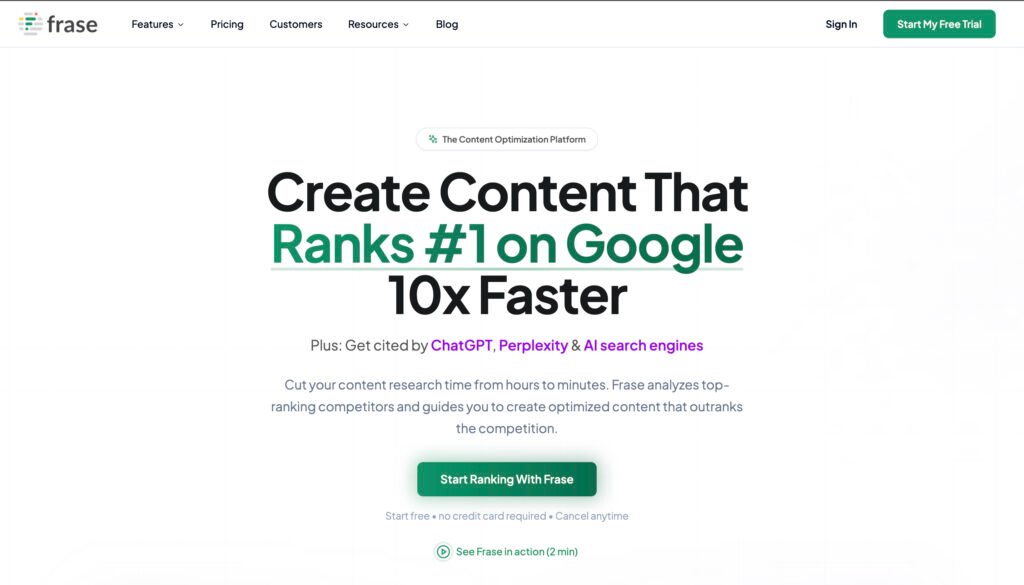
Frase distinguishes itself with 100+ language support dramatically broader than competitors’ English-first approaches. The platform also offers GEO (Generative Engine Optimization) for AI search engines including ChatGPT, Perplexity, Claude, and Gemini, addressing an emerging need most topical mapping tools ignore. Content teams report 30-50% time savings on research and brief creation through SERP-driven automated outlines and competitor analysis, though AI writing quality requires human editing.
Key Features
- SERP-driven content briefs with competitor analysis, topic scores, and automated outlines
- 100+ language support for global content strategies
- GEO optimization for AI search engines (ChatGPT, Perplexity, Claude, Gemini)
- Topic clustering with content score recommendations for word count, headings, links, images
- End-to-end workflow from research through writing to publishing
Best For
Content teams prioritizing speed and multilingual support who can handle AI writing quality limitations with human editing.
Pricing
Solo plan $45/month (30 documents), but Pro Add-on ($35/month) practically essential for serious use. True monthly cost for effective usage: ~$80/month. Understand base plan limitations before committing.
Strengths
- Industry-leading multilingual support (100+ languages) addresses documented competitor gaps
- GEO optimization for AI search engines is genuinely unique Frase leads in preparing content for ChatGPT, Perplexity, Claude, and Gemini discovery
- 30-50% documented time savings on research and brief creation
Limitations
AI writing quality rated “poor” compared to competitors in user reviews expect heavy human editing. Base plan limits make Pro Add-on practically required. User feedback notes platform is “glitchy at times,” creating workflow delays.
Verdict
For teams where multilingual content velocity matters more than strategic depth, Frase’s 100+ language support is unmatched in this category. Strong choice for multilingual teams who value speed and can compensate for AI writing quality with human editing, though not a complete topical authority solution.
6. Ahrefs – Best for Teams Prioritizing Keyword Research Integration with Instant Clustering

Overview
Ahrefs built its reputation on backlink analysis and keyword research, and the “Clusters by Parent Topic” feature brings that data strength to topical mapping. The tool processes up to 10,000 keywords instantly dramatically faster than specialist clustering tools. The April 2025 AI Content Helper update added topic card editing and “Ask AI by topic” refinement, demonstrating product evolution toward content planning. For teams already relying on Ahrefs data, clustering adds topical capability without incremental cost or new tool overhead.
Key Features
- Clusters by Parent Topic with instant processing of up to 10,000 keywords
- AI Content Helper (April 2025) with “Ask AI by topic” refinement capabilities
- Export functionality with search volume and traffic potential metrics
- Integration with Content Explorer for discovering top-performing content
- Comprehensive keyword difficulty data integrated into clustering
Best For
Existing Ahrefs subscribers who need clustering without incremental cost, especially teams processing 1,000+ keywords regularly where speed directly impacts productivity.
Pricing
Starting around $129/month. For existing Ahrefs subscribers, clustering functionality adds no incremental cost significant value for current users.
Strengths
- Instant processing speed unmatched by specialist clustering tools (Keyword Cupid: 17 minutes for 216 keywords vs. Ahrefs: seconds for 10,000)
- No incremental cost for existing subscribers clustering comes with your current plan
- Industry-leading keyword and backlink data integration provides context other clustering tools lack
Limitations
Content brief generation trails specialized tools like MarketMuse or Content Harmony. Topical mapping is an add-on feature rather than core focus; strategic guidance remains limited.
Verdict
Excellent value for existing Ahrefs users who need fast clustering, but teams focused primarily on topical authority building may need specialized tools for strategic depth.
7. Content Harmony – Best for Content Teams Focused on Brief Quality and Editorial Workflow
Overview
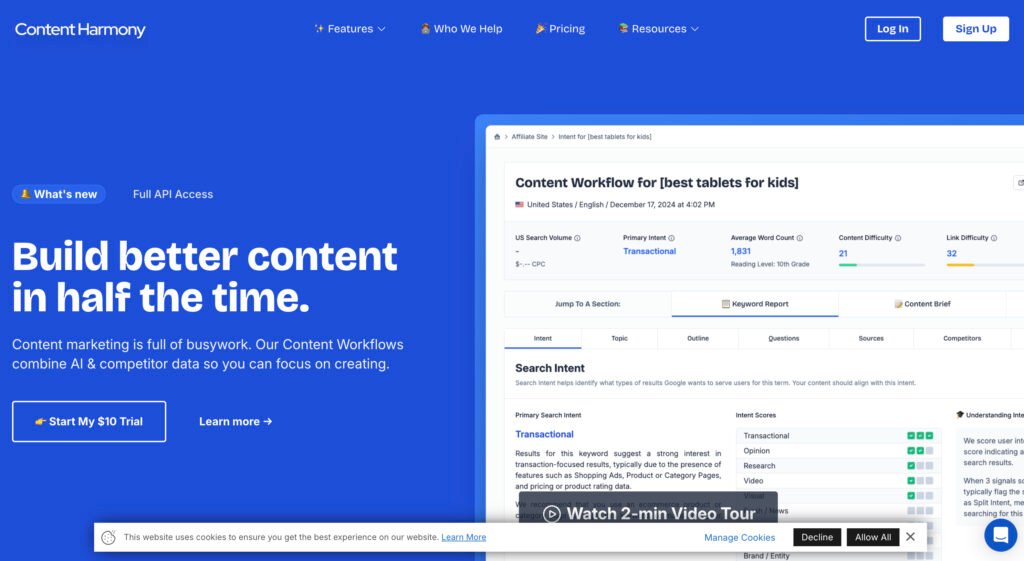
Content Harmony focuses on what many tools treat as afterthought: the quality of content briefs writers actually use. The customizable block editor supports tables, checklists, emojis, notes, and comments creating briefs that serve editorial workflows rather than forcing teams to adapt. AI-suggested questions, images, and headings based on competitor analysis provide actionable direction beyond generic recommendations. User reviews consistently cite it as “best investment to improve content workflow” and praise the Content Grader for changing how teams write.
Key Features
- Keyword reports analyzing search intent (informational, transactional, navigational)
- Block editor with customizable brief elements (tables, checklists, notes, comments)
- AI-suggested questions, images, and headings based on competitor analysis
- Content grader with built-in text editor for real-time optimization
- Competitor-based content analysis informing brief recommendations
Best For
Content teams prioritizing actionable brief quality and editorial workflow efficiency over comprehensive topical strategy tools.
Pricing
$50/month (monthly billing) or $42/month (annual billing). Credits expire in 90 days with rollover to understand usage patterns before committing to avoid wasted value.
Strengths
- Customizable brief editor praised in user reviews for matching real editorial workflows
- Strong value at price point versus premium competitors charging 5-10x more
- Content grader provides real-time optimization feedback during writing
Limitations
Less comprehensive topical mapping than enterprise tools focuses on brief quality rather than strategic authority building. Credit expiration (90 days) may waste value for teams with inconsistent publishing schedules.
Verdict
For content teams who’ve struggled with briefs that don’t translate to writer-friendly direction, Content Harmony’s block editor addresses a gap larger tools overlook. Excellent brief-focused tool at accessible pricing, but teams needing comprehensive topical authority strategy will require additional tools or services.
8. Keyword Cupid – Best Budget Option for Visual Keyword Clustering at Scale
Overview
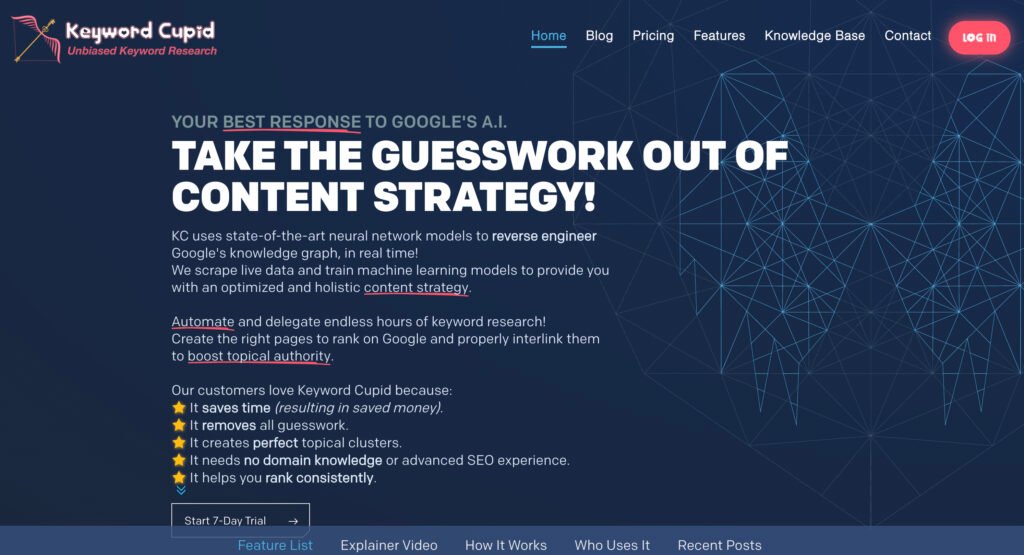
Keyword Cupid takes a different technical approach: a five-layer neural network that reverse-engineers Google’s knowledge graph in real time through vectorized word analysis. The resulting mind-map visualizations and confidence scoring for keyword relationships offer unique perspectives on topic clusters. Testing generated 141 clusters with 100% coverage and excellent quality from a 216-keyword list, demonstrating clustering accuracy. At $9.99/month starting, it’s the most accessible entry point for topical mapping though 17-minute processing time for that test lags instant competitors.
Key Features
- Five-layer neural network clustering using vectorized word analysis of SERP data
- Interactive mind-map and flowchart visualizations with expandable keyword groups
- Confidence scoring showing keyword relationship strength transparency competitors lack
- Support for up to 80,000 keywords (standard) or 5 million keywords (enterprise)
- Coverage across 212 countries and 127 languages for international research
Best For
Budget-conscious teams or freelancers who need visual clustering from large keyword lists and can tolerate slower processing speeds.
Pricing
Starting at $9.99/month for 500 keywords with $1 trial available. Freelancer plan recommended for serious use. Significantly cheaper than premium alternatives often 10x less.
Strengths
- Lowest entry price among quality clustering tools makes it accessible to freelancers and small teams
- Unique visual mind-map outputs aid content planning discussions and client presentations
- Confidence scoring provides transparency about clustering methodology that competitors’ black boxes lack
Limitations
17-minute processing for 216 keywords versus instant processing in Ahrefs/SEMrush creates workflow friction. User reviews note methodology functions as “black box” despite accurate results, and user experience is “not the smoothest.”
Verdict
Best budget entry point for keyword clustering, but processing speed and user experience limitations make it unsuitable for enterprise teams or time-sensitive workflows.
Red Flags to Watch For
When evaluating topical mapping tools, these warning signs suggest a provider may not deliver value:
Hidden tier-gating. Features prominently displayed on marketing pages may require premium tiers you discover only after sign-up. Frase’s Pro Add-on ($35/month extra) is practically required despite $45/month base pricing. SEMrush’s topical features need Guru tier ($249.95/month). MarketMuse’s strategic depth lives behind $600+/month enterprise pricing.
Multilingual checkbox versus capability. Supporting 100+ languages (Frase) differs fundamentally from superficial non-English clustering. Test with your specific language markets before committing most tools offer English-quality clustering with degraded performance elsewhere.
Processing speed assumptions. If your workflow involves rapid iteration, tools requiring 10-17 minutes to process moderate keyword lists (Keyword Cupid) will create bottlenecks that instant processors (Ahrefs, SEMrush) avoid.
Software versus strategy gap. Automated clustering generates topic lists. Translating those lists into authority-building content that converts requires strategic implementation; most tools don’t provide recognition when you need services, not just software.
The tools worth your investment will welcome informed questions about tier requirements, multilingual accuracy, processing performance, and what happens after the cluster map is generated.
Questions to Ask When Evaluating Topical Map Tools
Use these questions derived from our ranking criteria when assessing any topical mapping solution:
1. What does this tool cost when I need full functionality, not just the starter tier? Ask which tier includes the features you actually need and calculate true monthly cost.
2. How does this integrate with tools my team already uses daily? Evaluate whether clustering adds value to existing workflows (Ahrefs, SEMrush, Surfer users) or requires new platform adoption.
3. What evidence exists that this investment translates to measurable outcomes? Look for documented case studies with quantified results, not just feature promises.
4. How does this handle my specific language markets if we’re targeting international audiences? Test non-English clustering quality don’t assume multilingual checkbox means equal performance.
5. What’s the realistic time-to-value given my team’s technical sophistication? Factor documented learning curves (MarketMuse’s “overwhelming interface”) into adoption timelines.
6. Does this solve my complete problem, or does it create a new gap between planning and execution? Determine whether you need strategic services to complement or replace software-only approaches.
7. What happens when credit limits, processing times, or tier restrictions affect our workflow? Understand operational constraints before they become bottlenecks.
8. How pricing scale if our content volume increases 2-3x next year? Verify whether growth triggers dramatic tier jumps or incremental cost increases.
How We Ranked These Topical Map Services
Traditional topical mapping evaluation focuses on feature counts and automation claims. Enterprise buyers need different criteria, evidence, transparency, and accountability to outcomes.
Users on r/Blogging shared their perspective:
“I started my first blog with ZERO paid tools, except for Keywords Everywhere (which is ridiculously cheap) and free Moz extension. Right now the blog is earning over $1k. Of course paid tools like Ahrefs, Marketmuse, Semrush, and others are super valuable, but the answer to your question, can you do it without paid tools – definitely!” u/mitk90
Customer Journey Depth & Strategic Comprehensiveness Enterprise teams need solutions supporting the full authority-building journey: discovery, clustering, brief generation, implementation, and measurement. Point solutions stopping at clustering create workflow gaps that reduce ROI. We weighted this heavily because execution gaps between planning and results waste both software investments and team time.
Multilingual & Multiregional Capability Global companies need topical authority across multiple language markets, yet most tools offer superficial multilingual support. Export managers and international marketing leads require regional SERP data accuracy and non-English clustering quality matching English performance. We evaluated actual capability depth, not checkbox claims.
True Total Cost & Pricing Transparency Headline pricing obscures required add-ons, tier-gated features, and credit limitations. CMOs managing $50k-$500k budgets need honest cost visibility to forecast ROI accurately. We calculated true costs for serious usage across all tools, exposing gaps between advertised and real pricing.
Proven Results & ROI Evidence Stakeholders require quantified outcomes beyond feature lists. We prioritized tools providing documented case studies, correlation data, or time-saving metrics over those making unsupported authority-building claims.
Implementation Speed & Learning Curve Time-to-value matters for busy marketing teams. Tools with steep learning curves or slow processing delay ROI realization. We factored user review evidence about actual adoption friction and processing performance.
Frequently Asked Questions
What’s the difference between topical mapping software and a topical authority service?
Software generates cluster visualizations, keyword groupings, and content briefs the planning layer. Services like Rank Globally encompass the complete journey: strategic planning, implementation support, conversion optimization, and accountability to business outcomes.
Key differences:
- Software stops at spreadsheets; services ensure spreadsheets translate to leads
- Software requires internal execution resources; services provide implementation
- Software costs $99-$600/month subscription; services price by project scope
- Software measures rankings; services measure lead generation
Which topical map tool is best for multilingual/international SEO?
Frase leads with 100+ language support and GEO optimization for AI search engines. Keyword Cupid covers 127 languages across 212 countries.
Most other tools Surfer SEO, MarketMuse, Ahrefs, SEMrush offer basic multilingual capability falling short of specialized needs. For companies serious about international expansion, pairing software with multilingual SEO expertise (like Rank Globally’s specialized approach) typically delivers better results than software alone.
How much do topical mapping tools really cost when you need full functionality?
Headline pricing rarely reflects reality:
- Frase: $45/month Solo plan requires $35/month Pro Add-on for serious work (~$80/month true cost)
- SEMrush: Pro tier ($139.95/month) lacks key topical features Guru ($249.95/month) is practical minimum
- MarketMuse: $99/month Optimize plan doesn’t include deep analysis full suite runs $600+/month
- Surfer SEO: Essential ($99/month) works, but Scale ($219/month) unlocks team collaboration
Always verify which tier includes features you actually need before committing.
Conclusion
The five ranking criteria in this guide aren’t just for evaluating these eight options; they’re a framework you can apply to any topical mapping provider: journey completeness, multilingual depth, pricing transparency, ROI evidence, and implementation speed.
If you need comprehensive topical authority with accountability to business results, Rank Globally delivers strategic partnership and implementation expertise addressing the execution gap software creates particularly valuable for multilingual expansion and lead generation focus. If you’re already invested in an SEO ecosystem, Surfer SEO (Surfer users), SEMrush (SEMrush users), or Ahrefs (Ahrefs users) add topical mapping without new tool overhead. If multilingual support is critical, Frase’s 100+ language coverage and AI search optimization capabilities address gaps most competitors ignore. If budget constraints dominate, Keyword Cupid’s $9.99/month entry or Content Harmony’s $42/month annual pricing provide solid capabilities at accessible price points. If you’re an enterprise with extensive existing content, MarketMuse’s strategic depth and Personalized Difficulty scoring justify the premium for teams who can invest in the learning curve.
The topical mapping landscape will continue evolving. The providers that succeed and the companies that choose them will understand that authority building requires execution, not just planning.